Remote UI/UX design for New York teams
UI/UX design agency for New York teams.
We design products and websites for teams in New York, from one studio in Surat, India. Your morning is our evening, so the main call lands inside our working day and the rest of the week runs on the file.
How we work with New York
One studio, in Surat. Half a day ahead, and it helps.
We are one studio, in Surat, in western India. We do not have an office in New York and we will not imply otherwise. What we do have is a decade of practice, a team of about eight, and a working rhythm built around a simple fact: your morning is our evening. A 9am call in Manhattan lands comfortably inside our working day, and the answers you asked for are usually written by the time the city opens its laptop lids.
The rest is asynchronous by default. You leave comments in Figma or a short recording at the end of your day; we act on them while New York sleeps and leave the next round of screens ready. One shared board holds the decisions, so nothing important lives only inside a call that half your team missed.
Distance changes nothing about the craft. Discovery, user flows, wireframes, visual design, prototypes and developer handoff all happen exactly as they would if we sat in the same building. The one real difference is that the file becomes the source of truth, which is usually an improvement: the decisions are written down, dated, and attached to the screens they are about.
Practically, that means the first conversation is a working session rather than a pitch. We ask about the users, the constraints and what has already been tried, and we leave with enough to begin. A common first step is the free 15-point UX audit: a reviewed look at the product as it stands today, with the problems named and put in order of what to fix first.
We are equally clear about what we are not. We are not a New York agency with a local team, and we do not present ourselves as one. If a brief needs a designer in the room three days a week, we will say so and point you towards a studio that fits. If it needs careful thinking, dense detail and a partner who replies within one working day, the distance rarely shows.
What New York briefs look like
Four sectors that shape the work.
Financial services
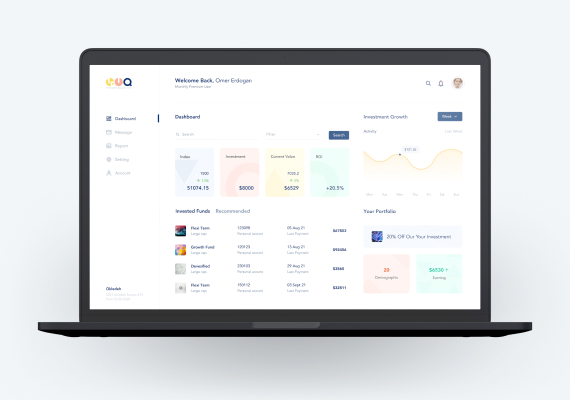
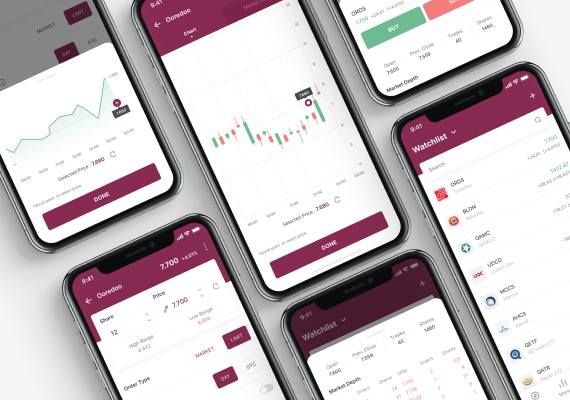
Trading screens, portfolio dashboards and reporting tools where a misread number carries a real cost. We design the dense states and the failure states, not only the clean one, because that is where a finance product is judged.
Media and publishing
Editorial layouts, subscription flows and content tools that have to survive daily publishing pressure, with type that holds up across a very short headline and a very long one.
Healthcare
Patient and clinician workflows where the interface carries clinical detail, permissions and a careful, unhurried tone rather than a marketing one. Small wording choices matter more here than anywhere else.
Real estate
Listings, search and map-led journeys for buyers, agents and landlords who read the same underlying data very differently, and who each need a different default view of it.
How it runs
The shape of a remote engagement.
A call in your morning
We hold the main review in your morning, our evening, and treat it as the single fixed point. Everything else moves in writing so nobody is asked to stay up for a stand-up or a status update.
Scope in writing first
You get the work described in plain language before it starts: what is designed, in what order, who reviews it, and what it costs. No open-ended hourly surprises and no scope that quietly doubles.
Feedback where the design lives
Review happens in Figma comments, short screen recordings and one decisions board, so every thread stays attached to the screen it is about and nothing is lost in an email chain.
Handoff your engineers can build from
Developer-ready files with a type scale, spacing rules, components and states, plus time with your engineers when they want to walk the build before it ships.
Context
A market that sets its own bar.
New York teams move at a speed that leaves little room for a slow design partner. Briefs arrive with a date attached, the stakeholder list is long, and the quality bar is set by the products that surround yours. A studio outside that market can be an advantage: we are not pulled between ten other Manhattan projects in the same week.
The industries that dominate the city also shape the design problems. Financial services needs precision and every state that survives a market open. Media and publishing needs layouts that hold under daily editorial load. Healthcare needs interfaces quiet enough to carry clinical detail. Real estate needs search and map flows that stay legible when the inventory is thin.
None of that requires a local address. It requires someone who reads the brief carefully, asks the awkward question early, and shows work often enough that there are no surprises at the end. That is the part we can control, and it is the part that decides whether a remote engagement works or quietly drifts.
We will not claim a New York client list we do not have. What we can show is twelve real projects across seven industries, a decade of practice, and a team of about eight who approach a Manhattan fintech brief the same way we approach any dashboard: from the decisions the person on the screen actually has to make.
The result we aim for is boring in the best way: predictable rounds, work you can review without booking a meeting, and a partner who tells you early when an idea will not survive contact with a dense screen. New York clients tend to value that directness, and we lean that way by default.
Questions
What New York teams ask us.
Do you have an office in New York?
No. We have one studio, in Surat, India, and we work with New York teams remotely. We say that at the start rather than imply a local presence we do not have, because a client who needs someone on site should be able to rule us out quickly.
How do calls work across the time difference?
Your morning is our evening, so a 9am call in New York lands comfortably inside our working day. We put the main review there and keep the rest asynchronous, so nobody is asked to join a call at midnight or rearrange an evening.
Can you keep up with a US product team’s sprint cadence?
Yes. We align design reviews to your sprint boundaries and hold a steady rhythm between them, provided decisions are recorded in the file as they are made. The cadence only works if the decisions travel with the screens.
What do you need from us to start?
A short brief, access to anything already live, and one named person who can approve design decisions. A link to the product is the fastest way to begin, and if you send one we will come back with the free 15-point UX audit.
Do you sign NDAs and work with regulated teams?
Yes. We sign yours or ours before sensitive material is shared, and financial and healthcare teams commonly ask for exactly that up front. We can also work inside your own review and approval process.
Get a free 15-point UX audit of your product.
Send us the link. Within one working day you get what to fix first, and why.
Contact
Start a project
Tell us what you are building. We reply within one working day.
- +91-8866301464
- info@ixdesign.in
- Mon–Fri 9:00–18:00 · Sat 9:00–13:00